This week, I had the privilege of hearing a phenomenal speaker at a leadership conference—Kath Koschel, founder of The Kindness Factory. Her story and message moved me deeply, and I knew it would be the perfect inspiration for today’s Front-Row Friday.
Kath’s story is nothing short of remarkable. After breaking her back and enduring five unsuccessful surgeries, she finally had one last operation that allowed her to learn to walk again—despite having no feeling in one lower leg. She not only walked but went on to compete as a Paralympic Ironman athlete.
Then tragedy struck again. While training for the main Ironman competition that she qualified for, she was hit on her bike by a drunk driver and broke her back a second time. Once more, she had to learn how to walk. Through these painful journeys, Kath experienced firsthand how kindness from others fueled her healing and positively impacted her rehabilitation.
Instead of letting bitterness win, she studied kindness—ten years of research that led her to discover something extraordinary: kindness doesn’t just change lives emotionally, it changes lives organizationally.
The Science of Kindness
Kath found that when you give, receive, or even witness acts of kindness, your brain releases serotonin and oxytocin—two powerful “feel-good” hormones. That means kindness isn’t just good for the heart; it’s good for your health. But she also discovered something even bigger: the business case for kindness.
Organizations that actively foster kindness—not just being “nice,” but truly seeing, hearing, and valuing others without expecting anything in return—see measurable results:
- 23% increase in profitability
- 66% increase in employee well-being
- 18% increase in productivity
Kindness is more than a soft skill, it’s a core still that when applied becomes a competitive advantage.
Active vs. Passive
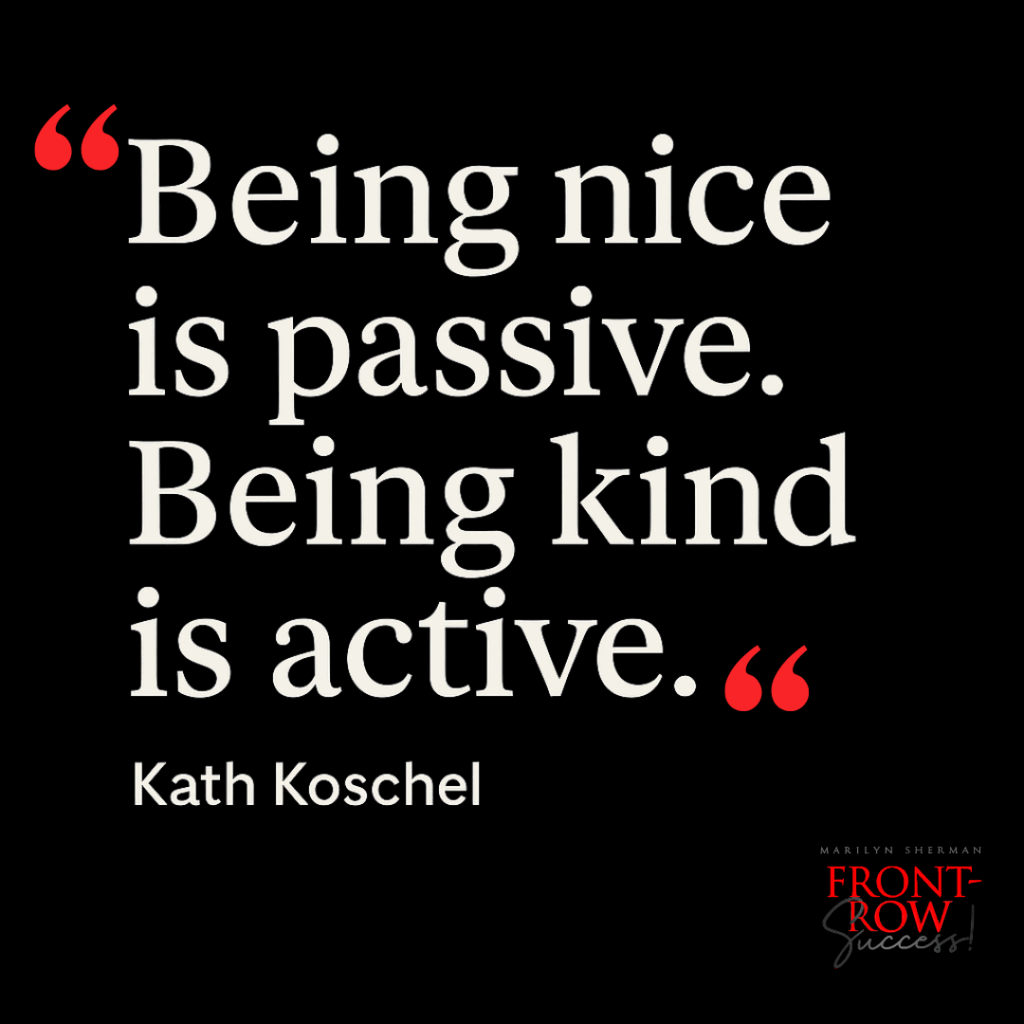
Kath draws a powerful distinction: Being nice is passive. Being kind is active. Kindness requires intention. It requires awareness. And it requires courage to act without expecting something in return.
Kindness in Action
Through the Kindness Factory, Kath set a goal of documenting 1 million acts of kindness. Today, ten years later, that number has grown to over 8.5 million documented acts—ranging from something as simple as a smile or a wave, to something as life-changing as donating a kidney.
Kindness doesn’t have to be monumental to matter. Even the smallest gesture can ripple out and transform someone’s day—and yours.
Your Front-Row Challenge
This Front-Row Friday, I encourage you to actively choose kindness.
- Smile at a stranger.
- Hold the door open for someone.
- Send a note of appreciation.
- Offer your full attention when someone needs to be heard.
You’ll make someone else feel seen and valued, and in the process, you’ll boost your own happiness and well-being.
Because one way to ensure you get a front-row seat in life, is to show kindness to others. Thanks for choosing kindness today. I appreciate you.
Your Head Usher,
Marilyn
PS: When I searched for the kindness factory, there were tons of organizations that are dedicated to kindness which I found awesome! Kath’s organization is www.KindnessFactory.com.